
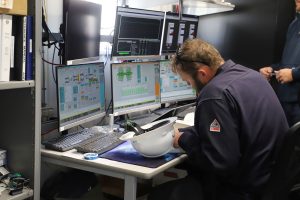
 The Indiana Municipal Power Agency (IMPA) provides wholesale power through a variety of resources, including coal, natural gas, renewables, battery storage, and purchased power. As a part of this diverse portfolio, IMPA owns seven combustion turbine (CT) units that offer dispatchable power during peak demand periods or to support reliability of the transmission system. Since 2024, these CT units have exceeded previous summer runtimes, operating at historically high capacity factors, meaning that they’ve operated much more than ever before. The dedicated staff members at IMPA’s three CT units in Anderson, IN and two CT units in Richmond, IN have consistently worked through nights and weekends to ensure the facilities are available when called upon. The Agency’s two other units in Indianapolis, IN, operated and maintained by AES Indiana, also provide pivotal resources in peak demand times, especially through the hot summer months.
These CT units, capable of operating on both natural gas and ultra-low sulfur fuel oil, provide 419 megawatts of capacity to the Agency’s power supply portfolio. IMPA’s CT technicians work hard to manage and maintain this critical portion of IMPA’s resources, dedicating prolonged hours to running the facilities when communities need power the most. When the CTs aren’t operating, this team conducts maintenance and repair work, ensuring that the units remain available.
In addition to conducting maintenance when not operating, IMPA’s CT staff pursue significant upgrades to the units to increase the useful life of these facilities. By the first of the year, the CT team completed an extensive project to incorporate reverse osmosis (RO) water treatment systems into the plants to improve operating efficiency and reduce costs. Now, the CT staff are utilizing these systems to create ultrapure water for the combustion turbines’ NOx control rather than relying on less efficient, maintenance intensive, demineralizers. The RO investment decisively improved these peaking power plants, helping IMPA maintain asset control, safety, and reliability through this summer’s heat wave.
These improvements are always conducted ahead of seasons that experience high electric demand, ensuring that the units are available during peak times. In preparation for the summer season, the CT crew also completes planned outage maintenance, conducts system checks, and undergoes heat stress training. Employees work around the clock at these units through hot weather, being scheduled on-call and working overtime when needed to bring the CTs on at a moment’s notice. IMPA preserves alternative back-up fuel resources to natural gas, the primary fuel, in case of unexpected weather events, transportation issues, or economic downturns as well. Approximately 800,000 gallons of liquid fuel is kept at both IMPA’s Anderson and Richmond plants to serve as backup. The careful planning and management implemented by IMPA’s CT staff are what make these resources reliable and efficient for the Agency’s use.
The increase in reliance on CTs is expected to continue in the future as a result of the increasingly limited supply of dispatchable resources to supply the increasing system loads and to backup the intermittency of renewable resources.
“The capacity factor of each of our CT units has more than doubled since 2023,” said Jack Alvey, President and CEO of IMPA. “Units are being called on almost every day through the summer in PJM territory, which is where our Anderson and Richmond units are located. These units are experiencing unprecedented runtimes. I’m proud of our CT staff for keeping up with the demanding summer schedule. IMPA’s management and Board of Commissioners is working to support these employees through this change in the industry due to the load increases and power supply makeup that is requiring the grid operators to depend much more on these peaking units.”